The first time I rode a borrowed CRF250R at a sand track outside Bakersfield, I did what every street rider does: I sat down, gripped the bars like they owed me money, and leaned my shoulders into the corner. Two laps later I was on my back in the sand, staring at the sky, wondering why a bike with 38 horsepower had just thrown me off like a mechanical bull. The answer wasn’t the bike. It was my body position on a dirt bike, and it took me three seasons and one cracked rib to actually understand what that phrase means.
Here’s the honest version — not the textbook version. Nine things that matter, in roughly the order I wish someone had explained them to me.
Start With Your Feet, Because Everything Else Follows
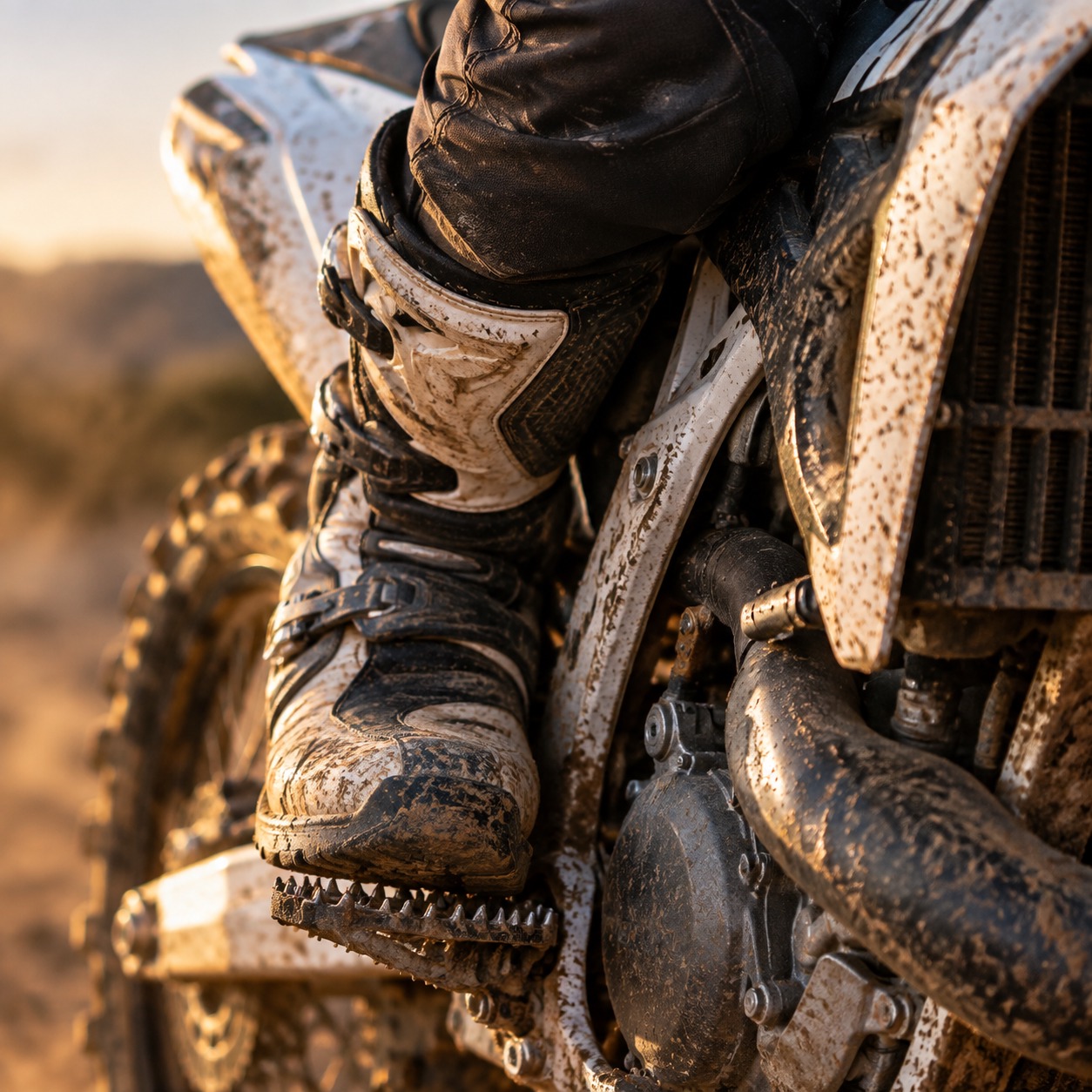
I spent two years obsessing over where my elbows were while my boots were doing nothing. That’s backwards. Your pegs are the only real connection between you and the bike that isn’t a control input. Hands and arms steer, but feet carry load.
Stand on the balls of your feet, not the arches, and not the heels. When I switched to the balls of my feet, my ankles suddenly had range to absorb bumps instead of transmitting them straight into my knees. On a whooped-out section that used to rattle my fillings loose, I could suddenly stay on the gas about 15 percent longer before the rear end started swapping.
Ride with your toes pointed slightly inward, almost pigeon-toed. It feels stupid for the first hour. Then you notice your knees naturally grip the tank and shroud without you thinking about it, and the bike stops wandering on off-camber hardpack.
The peg-weight mistake almost everyone makes
Most riders weight the outside peg in a corner and call it done. Half right. You want pressure on the outside peg, but you also want the inside foot light enough that it isn’t dragging the ground or propping the bike up. I ran a GoPro pointed at my feet for one moto and discovered I was standing almost entirely on my inside foot through right-handers. No wonder the front kept tucking.
Elbows Up Is Not a Slogan, It’s a Measurement
“Elbows up” gets repeated so often it stops meaning anything. Here’s the version that helped me: your forearm should be roughly parallel to the ground when you’re standing in the attack position. Not angled down toward the grips. Parallel.
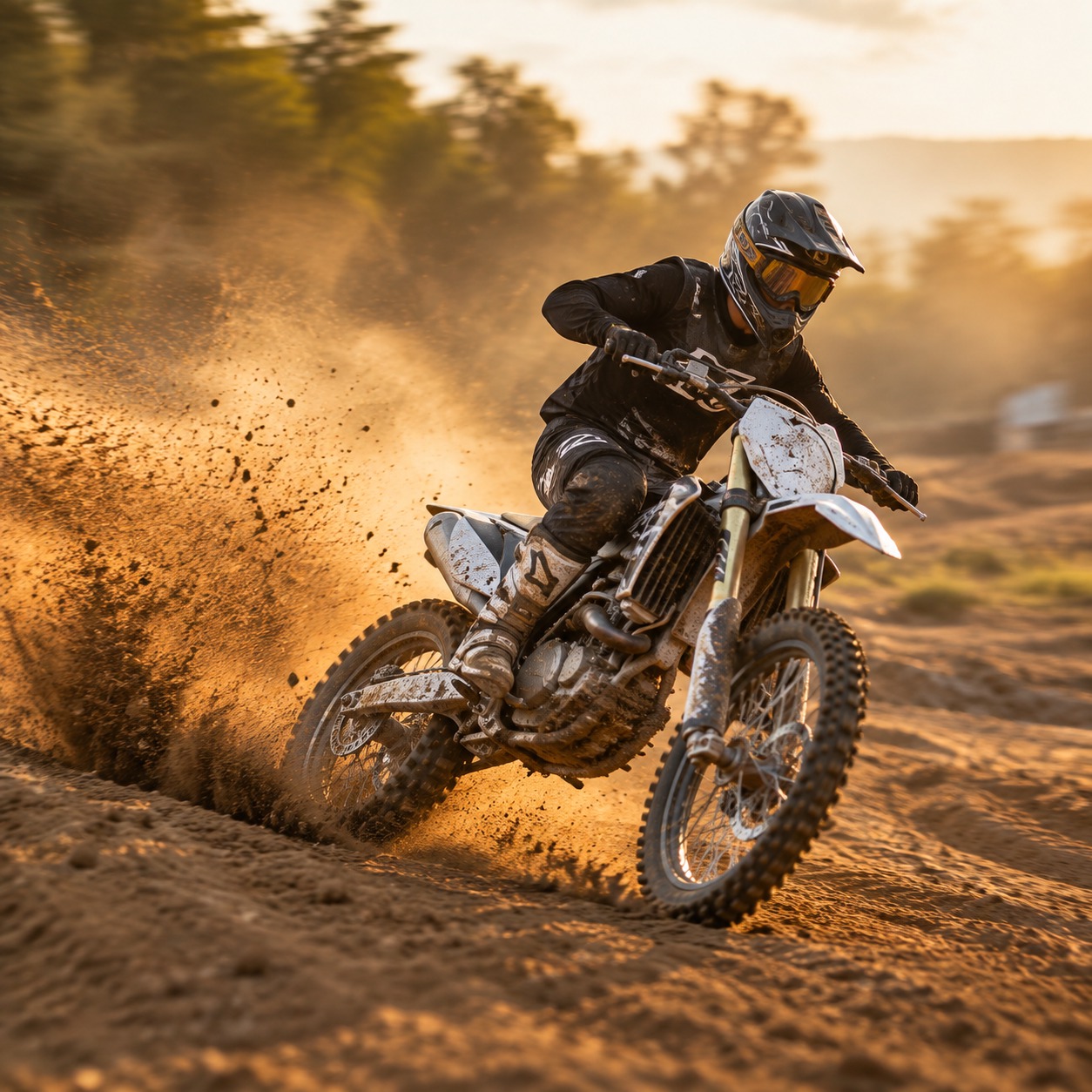
When your elbows drop, your whole upper body collapses forward, your chin ends up over the bar clamps, and you lose the ability to push the bike down into the dirt. I fixed this with a cheap trick — I rotated my levers down about 8 degrees and moved my perch inward roughly 10mm. Suddenly my wrists weren’t bent at a weird angle and keeping elbows up stopped feeling like a workout.
Also, grip the bars like you’re holding two small birds. Not strangling them, not letting them fly away. Death-gripping the bars is the single fastest way to arm pump. I used to get it 12 minutes into a 25-minute moto. After consciously loosening my grip and relying on my legs for stability, I finished a full moto without stopping to shake out my hands for the first time in a year.
Standing vs. Sitting: The Decision Tree
Newer riders sit too much. Slightly experienced riders stand too much and wonder why they’re exhausted. The real answer is that you’re constantly transitioning, and the trigger is simple:
- Braking bumps into a corner: stand, weight back, then sit as you tip in
- Long rutted corner with traction: sit, weight the outside peg, get your chest over the tank
- Whoops: stand, hips back, let the bike move under you
- Steep downhill with loose rocks: stand, weight way back, arms extended
- Flat hardpack straight with grip: sit, relax, save energy
I burned an entire summer standing through everything because a faster guy told me “real riders stand.” He also weighed about 30 pounds less than me and rode a 125. Context matters more than rules.
The Attack Position, Broken Into Steps
This is the one drill I still run at the start of every ride, for about five minutes, in second gear on a flat area. It’s boring. Do it anyway.
- Stand with the bike centered under you. Not behind the seat, not over the bars. Your belly button should be roughly above the middle of the seat.
- Bend at the hips, not the waist. Push your butt back like you’re about to sit on a stool that isn’t there. This keeps your spine neutral instead of rounded.
- Head over the bar clamps. Not looking down at your fender. Your chin should be above the triple clamp area when you’re neutral.
- Knees bent, gripping the shroud. You should be able to squeeze and feel the plastic against your knee pads.
- Elbows parallel to the ground, fingers on the levers. One finger on the clutch, one or two on the brake.
- Feet on the balls, toes in. Same as above.
- Then move. Roll on the throttle and let the bike pull you slightly backward, then push forward again. Your body should be a counterweight, not a passenger.
Five minutes of this before every ride, for a month, changed more about my riding than any suspension revalve I’ve paid for. And I’ve paid for three.
Cornering: Where Body Position Actually Wins Races
Everyone talks about the attack position. Races are decided in corners. Here’s what took me embarrassingly long to learn.
You sit for most corners, but you sit forward and to the outside. Your inside leg comes off the peg and points toward the inside of the turn, knee bent, foot near the front axle. Not dragging on the ground like a road racer — that’s a good way to catch a rut and break an ankle. I watched a guy do exactly that at a local race two years ago. He was fast, too. Ambulance took him off.
Your outside elbow stays up and out. Your head turns to look at the exit, not the apex. And your weight goes onto the outside peg and the outside edge of the seat.
One number that surprised me: on a 180-degree sand corner, moving my hips about 4 inches toward the outside of the turn cut my lap time by nearly a second and a half on a 90-second loop. Same line, same braking point. Just body position.
Common Mistakes That Cost Me the Most
Sitting too far back on jumps. I cased a double at a track in Pala because I was hanging off the back like I was on a hill climb. Land front-wheel-low and you’re going over the bars.
Death-gripping in the air. Your body should be relaxed at the lip. If you’re stiff, the bike goes wherever the last bump sends it.
Leaning the wrong way in ruts. In a deep rut, you lean with the bike, not against it. Fighting the rut is how you climb out of it sideways.
Never adjusting the cockpit. Stock bar position works for a 5’9″ rider. If you’re 6’2″ or 5’5″, you’re fighting the bike before you even start. Bar risers, different bend, rotated levers — these are cheap fixes with outsized returns.
If you want a structured progression rather than my trial-and-error version, more drills and setup guidance are worth reading at before your next practice day.
Fitness Is Part of the Position
You can have perfect technique and still fall apart at minute 18 because your core gives out and your elbows drop. I started doing three sets of plank variations and single-leg deadlifts twice a week, nothing heroic, about 25 minutes total. Within six weeks I stopped losing my form late in motos. That’s a body position fix as much as a fitness fix.
One more thing, and I say this as someone who learned it the hard way: if your lower back hurts after every ride, you’re probably rounded at the waist instead of hinged at the hips. Fix that before you buy another set of handlebars.
Your position isn’t a pose you hold. It’s a conversation you’re having with the bike, constantly, and the bike never stops talking.