Last October I watched a guy unload his truck at a trailhead outside Moab, dig through a duffel for ten minutes, and come up with one glove. He’d driven four hours. His bike was fine. His day was over before it started. That’s the moment I started keeping a written gear bag packing list instead of trusting memory, and it’s saved me at least three rides since.
What follows is the exact system I use, including weights, quantities, and the two items I cut after realizing they were dead weight.
Start With the Bag Itself, Not the Contents
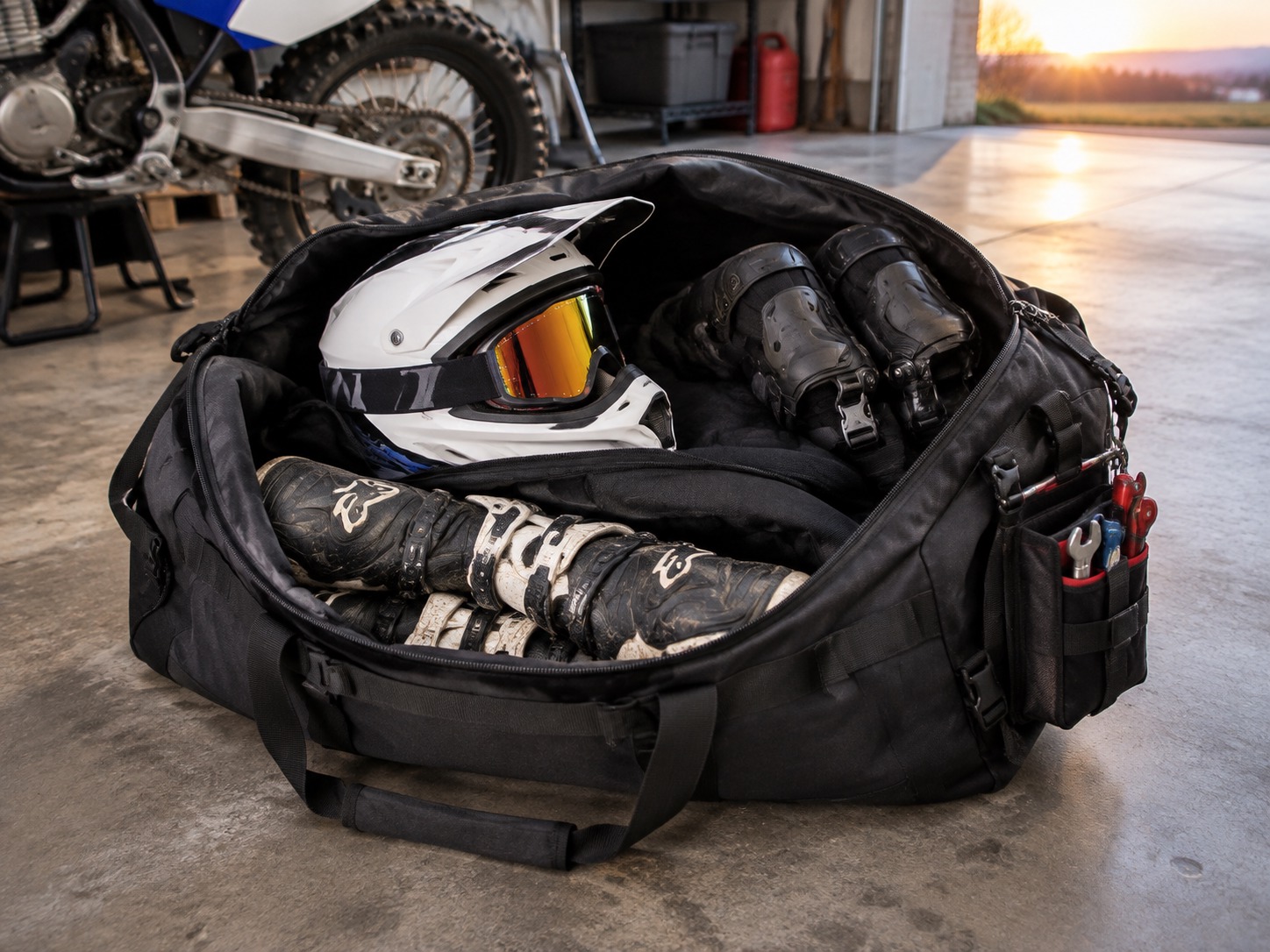
Most people buy gear first and a bag last, which is backwards. I run a 40-liter duffel with a hard bottom panel and two external compression straps. Forty liters sounds small until you actually weigh what goes in: my full kit lands at 18.5 pounds dry, and that includes boots. A 60-liter bag just encourages you to bring junk.
The hard bottom matters more than the brand. Wet boots and a muddy skid plate will destroy a soft-sided bag from the inside out within a season. I’ve had the same duffel for four years and the only failure was a zipper pull I replaced for $4.
Two-Bag vs. One-Bag
I split my kit into a main duffel and a small 8-liter tool pouch that clips to the outside. Reason: if I need a 10mm wrench mid-ride, I’m not unpacking gloves and goggles to find it. The pouch rides on the duffel’s D-rings, so it’s still one thing to carry from the truck.
Total cost of my bag setup was about $120 for the duffel and $35 for the pouch. You can spend $300 on a rolling moto-specific bag, and I’ve tried one. The wheels added 3 pounds and got packed with mud the first wet weekend. Not worth it.
The Step-by-Step Packing Order
Order matters because it determines what you can reach without unpacking. Here’s how I load the bag, bottom to top.
Step 1: Boots and Heavy Base Layer (Bottom)
Boots go in first, toes pointing down and inward, soles against the hard panel. My Alpinestars Tech 7s are size 10 and take up roughly a third of the floor space. I stuff my knee braces inside the boot shafts. That’s two bulky items occupying space that would otherwise be wasted.
Step 2: Riding Pants and Jersey (Middle)
Rolled, not folded. A rolled pair of riding pants takes about 40% less vertical space than a folded one and doesn’t crease at the knee. I bring one set on the bike and one spare in the bag. The spare has saved me twice, once after a creek crossing that turned a dry ride into a wet one.
Step 3: Helmet, Goggles, Gloves (Top)
Helmet goes on top, crown up, with goggles inside it and a spare lens tucked in a microfiber bag. I carry two pairs of gloves: one vented for anything above 75°F, one insulated for early starts. Two pairs weigh 11 ounces combined. Cold hands end rides faster than cold anything else.
Step 4: Hydration and Fuel Add-Ons (External)
A 3-liter hydration bladder goes in the helmet bag’s side pocket, empty. I fill it at the trailhead, not at home, because a full bladder sitting in a hot truck for three hours tastes like plastic. I also carry a 1-liter bottle of premix in a separate sealed bag. That’s a 32:1 mix for my two-stroke, enough for roughly 25 miles of hard trail riding.
Step 5: Tools and Spares (Clipped Pouch)
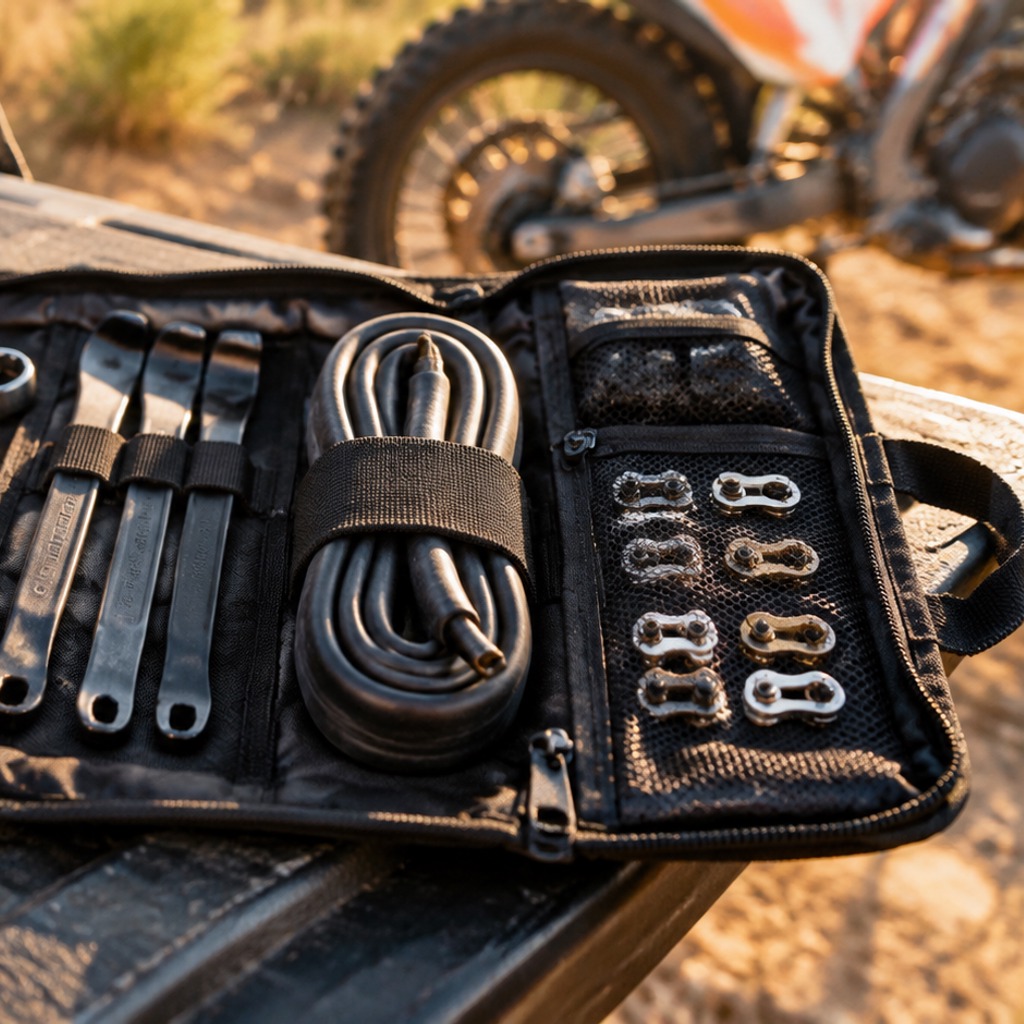
Here’s what actually lives in the 8-liter pouch, weighed on a kitchen scale:
- 8mm, 10mm, 12mm, 13mm combination wrenches: 14 oz
- T-handle with 8mm and 10mm sockets: 9 oz
- Tire levers, two: 5 oz
- Patch kit and a 21-inch spare tube: 1 lb 6 oz
- Master link, two spare: 1 oz
- Zip ties, 10 assorted: 2 oz
- Small first aid kit: 11 oz
- Multi-tool: 8 oz
Total: just under 4 pounds. I know that’s more than some riders carry. I’ve also been the guy sitting on a rock for 90 minutes waiting for someone with a spare tube. The math favors the pouch.
What I Stopped Carrying
Two things got cut after a season of tracking what I actually used.
First, a full socket set. I carried a 22-piece set for a year and used exactly three sockets. Now I carry those three.
Second, a second pair of goggles. I used to bring three pairs. The reality is that I swap lenses, not frames, and a spare lens takes a quarter of the space. If you’re building your own gear bag packing list, track your usage for five rides before you decide what’s essential. Most riders carry 30% more than they need and still forget the one thing that breaks.
One more habit worth building: I lay everything out on the garage floor the night before, photograph it with my phone, and pack from the photo. Sounds fussy. It takes four minutes and I haven’t forgotten a boot since.
Seasonal Swaps Worth Making
The kit isn’t static. From November through March I add a neck gaiter, a spare set of dry gloves, and a lightweight rain shell that packs to the size of a fist. That adds about 1.2 pounds. In summer I drop the shell and add a second hydration bladder, because 3 liters isn’t enough above 90°F.
The bag stays the same size year-round. That’s the point of packing to a weight and volume target instead of to a feeling.