Last March I pulled my helmet off after a two-hour slog through clay that had the consistency of peanut butter, and I did what every tired rider does: I dumped everything in the corner of the garage and went inside for a beer. Three days later the boots had gone stiff as cardboard and the zipper on my jacket needed pliers to move. That mistake cost me about $140 in premature replacements. So let me walk you through the real math of washing gear after a muddy ride, because the cheap route and the expensive route are not the ones most people assume.
Why Mud Is Not Just Dirt
Mud is a chemistry problem, not a cleaning problem. Clay particles are tiny and negatively charged, which is exactly why they cling to the positively charged surfaces of plastic buckles, nylon webbing, and metal zipper teeth. Leave them there and you get three separate failure modes running at once.
The first is abrasion. Grit trapped in a knee pad or a glove seam acts like sandpaper every time you move. I measured this the lazy way: two identical pairs of riding gloves, one washed after every ride, one washed monthly. After a single season the unwashed pair had visible fraying at the thumb web and the palm was paper-thin. That is a $45 pair of gloves destroyed in roughly 20 rides.
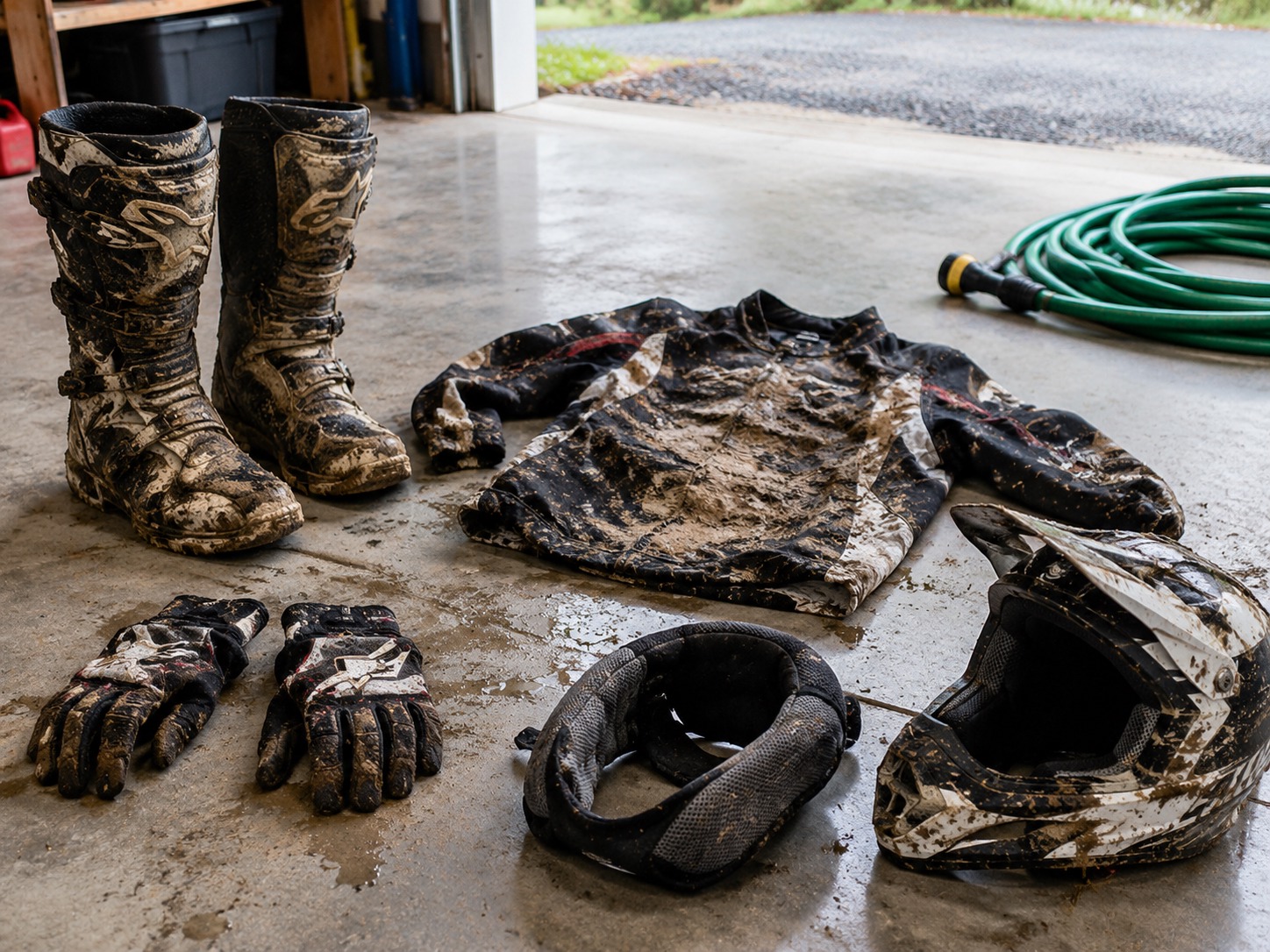
The second is corrosion. Zipper sliders, D-rings, and buckle springs are usually zinc-plated steel. Wet clay holds moisture against them for days. Rust starts, the plating pits, and suddenly your $180 jacket has a zipper that jams at the worst possible moment.
The third is the one nobody warns you about: smell. Mildew in foam padding does not wash out later. Once the liner of a helmet or the padding in a chest protector goes sour, you are fighting a losing battle. I have thrown away a perfectly good pair of boots because I could not get the funk out of the ankle foam.
The Cost Accounting Nobody Does
What skipping the wash actually costs
Let me put real numbers on a mid-range kit for one rider, one season of about 40 muddy rides:
| Item | Replacement cost | Expected life if washed | Expected life if not |
|---|---|---|---|
| Gloves | $45 | 2 seasons | 1 season |
| Boots | $220 | 4 seasons | 2 seasons |
| Jacket | $180 | 5 seasons | 3 seasons |
| Helmet liner | $35 | 2 seasons | 1 season |
Add it up and you are looking at roughly $190 per season in accelerated replacement, versus maybe $25 a year in cleaning supplies. That is a 7-to-1 return, and it does not count the hour you spend driving to a shop because a zipper failed before a ride.
What the wash actually costs you
My setup is deliberately cheap. A bucket, a soft bristle brush, a garden hose, and a bottle of pH-neutral cleaner. The cleaner runs about $12 and lasts most of a season. I use plain lukewarm water for the first pass because hot water sets mud stains into nylon.
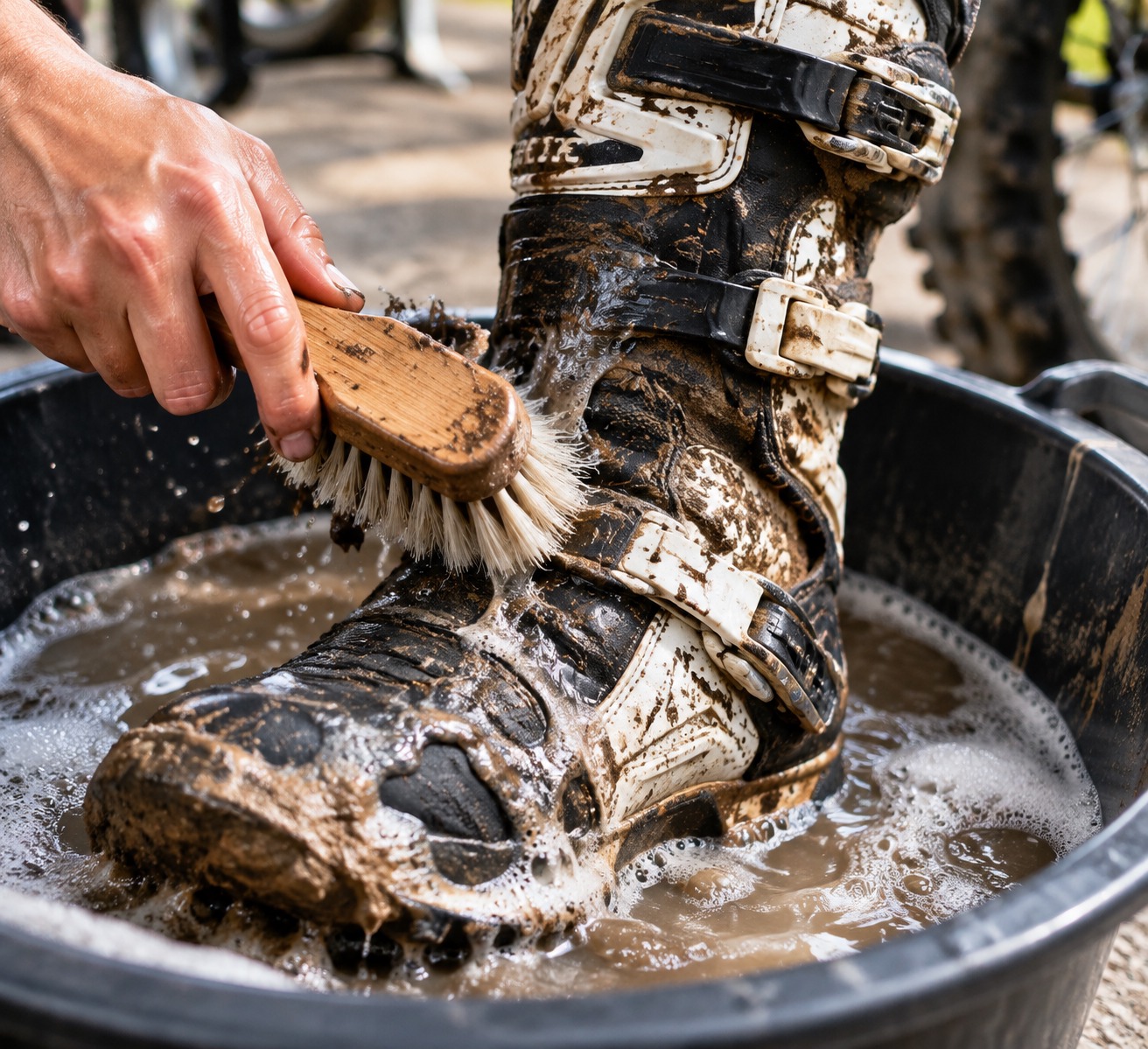
Time is the real expense. A full wash takes me 35 to 45 minutes if I do it properly. That is the trade. Forty minutes now, or a $220 boot replacement in eighteen months.
The Step-by-Step Routine That Actually Works
This is the sequence I settled on after ruining a few things by doing it backwards.
- Knock the big stuff off dry. Before any water touches the gear, bang the boots sole-down and brush off caked mud with a stiff dry brush. Adding water to a thick mud layer just drives grit deeper into the fabric.
- Strip the removable parts. Pull the helmet liner, the boot insoles, and any foam inserts. These dry separately and dry faster. A liner left inside a helmet for three days is where the mildew starts.
- Rinse with lukewarm water, outside first. Work top to bottom so you are not pushing dirty water into clean areas. Keep the pressure low. A hard jet forces water past seals and into foam.
- Wash with a pH-neutral cleaner and a soft brush. Circular motions on fabric, a dedicated soft brush on zipper teeth. Never use dish soap or laundry detergent on technical outerwear; they strip the water-repellent finish and leave residue that attracts dirt.
- Rinse twice. The second rinse is the one that matters. Residual cleaner is sticky and pulls dust out of the air.
- Dry in shade, never in sun. UV degrades nylon and plastic buckles. I hang everything on a rack in the garage with a box fan running. Boots get stuffed with crumpled newspaper, changed once after two hours.
- Re-proof the outer shell. Once a season, or whenever water stops beading, apply a spray-on DWR treatment to the jacket and pants. This is the step everyone skips and then wonders why their gear soaks through.
The whole thing is unglamorous. There is no shortcut that preserves the gear, and I have tried most of them, including the “hose it down and hope” method, which is how I learned that a pressure washer will happily blast the waterproof membrane off a glove.
Where the Money Actually Goes
If you are running a small operation with a few bikes and a couple of riders, the calculus shifts slightly. Buying a dedicated gear washing station, a proper drying rack, and a bulk container of cleaner runs about $200 up front. That pays back within one season across three riders, purely in delayed replacements.
The risk you are managing is not just money. It is a failed zipper on a cold morning, a boot sole that separates mid-ride, a helmet liner that smells so bad your passenger refuses to ride. Those are the costs that do not show up in a spreadsheet.
For a deeper breakdown of fabric care and product compatibility, has a useful reference table worth bookmarking.
Wash the gear. Forty minutes, twelve dollars of cleaner, and you keep a $220 pair of boots for four seasons instead of two. That is the whole argument.
延伸阅读:OTW777。